Since 2022, Australia’s oldest family-owned logistics business has rebuilt its HSE Management System from the ground up — and cut its Potential Serious Injury Fatality Frequency Rate by over 91%.
Australia’s oldest family-owned logistics business · Est. 1829Scroll
Roots dating back to 1829. A national operation with global reach, a complex multimodal risk profile, and safety written into its core values.
Sadleirs boasts a distinguished and rich heritage as Australia’s oldest family-owned logistics business. Established in Western Australia with roots dating back to 1829, Sadleirs has grown to become a national operation, with global reach. Known for its ‘customer-first’ approach, Sadleirs has a strong safety culture, encapsulated in one of its core values, “Sadleirs Accident-Free Every Day (SAFE).”
In recent years, Sadleirs has made significant strides in improving its Occupational Health and Safety (OHS) management system, focusing on consistency, risk management, and user engagement.
01The operation today
0
People employed across Australia
0
Engaged contractors
0
States of operation
0
Private rail sidings owned and operated
Today, Sadleirs employs more than 400 people across Australia, supported by approximately 100 engaged contractors. Sadleirs provides a complete logistics offering spanning interstate and intermodal transport, global freight forwarding, international shipping services and specialised packaging solutions.
The business operates across Western Australia, Victoria, Queensland, South Australia and New South Wales, and owns and operates private rail sidings at its Perth, Melbourne and Sydney sites. This multimodal, multi-jurisdictional footprint creates a complex risk profile spanning heavy vehicle operations, dangerous goods handling, rail siding activity and a large distributed workforce.
The turning point · January 2022
In January 2022, a new National Safety Manager was appointed to lead a comprehensive overhaul of the safety system.
Amidst changing business landscapes, Sadleirs identified significant opportunities to enhance safety and efficiency through a unified, national approach. Past safety practices varied across states, which highlighted the opportunity for a more cohesive system to improve effective risk management.
The existing system had been WA-centric, and did not best cater to the national operations of Sadleirs. This shift created opportunities to standardise safety practices and improve overall efficiency and effectiveness.
02
Question 1
The root cause was structural.
A safety system that had grown organically at state level, inside an operation that had long since become national.
Ahead of 2022, Sadleirs’ safety practices were state-based rather than national.
More than 70 procedures existed in varied formats, with no standardised way of capturing or monitoring risk and no central location to store or access critical risk information. There was limited organisational consensus on Sadleirs’ key risks, and existing tools and formats were not well suited to supporting a national, human-centred approach to safety.
02Seventy procedures, no single shapeeach dot = one procedure
0→0
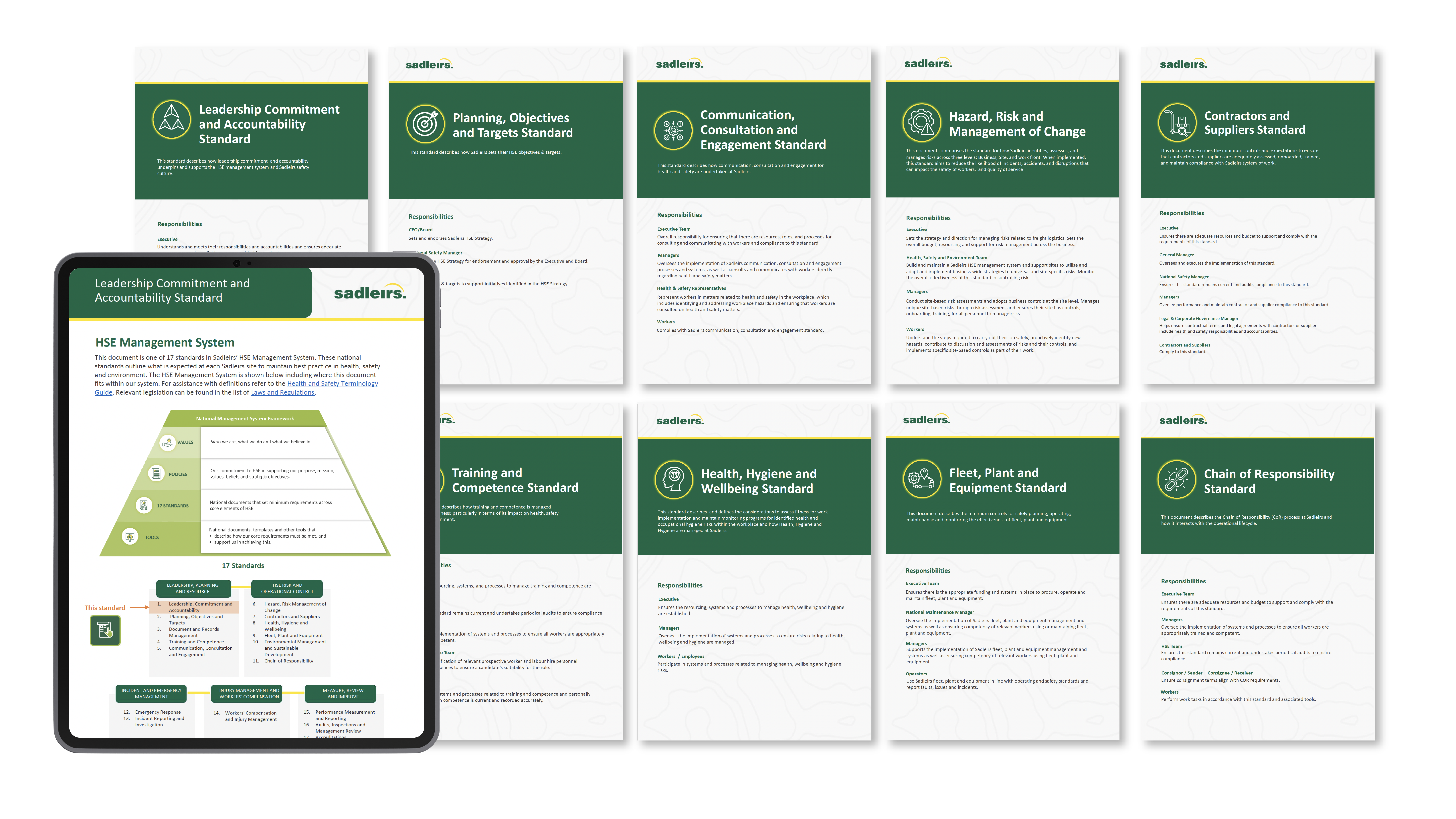
More than 70 procedures in varied formats were consolidated into 17 standardised national standards, and 77 detailed documents reduced into a simplified, human-centred format.
This varied approach extended across the business’s HSE management system, training framework, and verification of competency processes, creating separate risk controls across a geographically dispersed, multimodal operation involving heavy vehicles, dangerous goods, rail siding activity and a large contractor workforce.
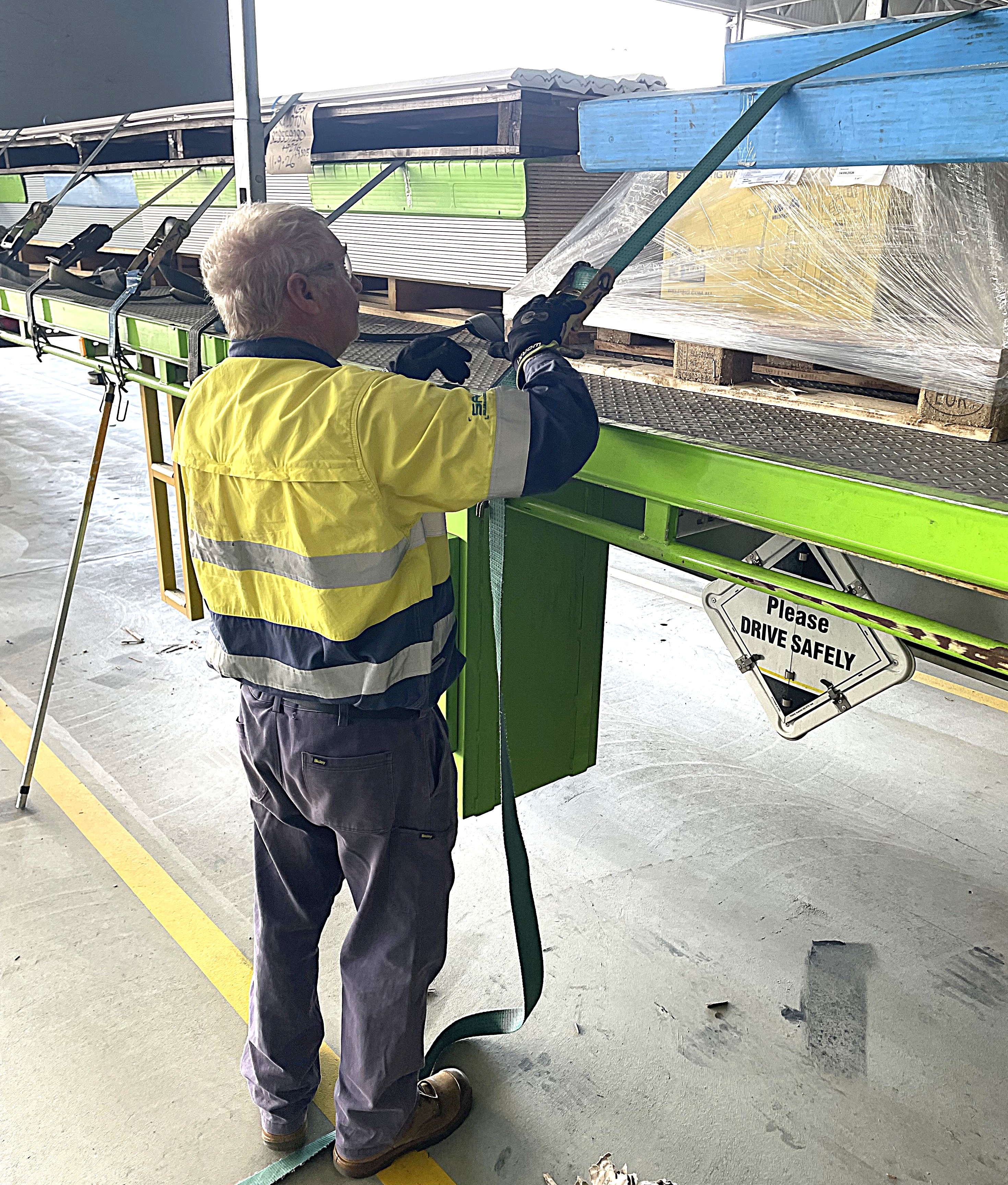
Operationally, the nature of Sadleirs’ transport and logistics work exposes employees and contractors to manual handling, load restraint and mobile plant risks. Prior to 2023, Sadleirs’ incident recording system did not consistently or accurately capture root cause and contributing factor data, making it difficult to identify genuine trends. The uplift has directly closed this gap: across the January 2025 to July 2026 reporting periods, incident investigations now consistently identify human factors, particularly situational awareness, complacency and desensitisation to hazards, and experience, knowledge and skill gaps, as the leading contributing cause, with the back, shoulders and knees among the most commonly affected body areas.
The root cause
The root cause of these challenges was structural: Sadleirs’ safety system had developed organically at a state level rather than being designed for a national operation, leaving no consistent framework to identify, prioritise or manage risk consistently across sites.
Left unaddressed, this structure materially exposed the business to safety, compliance and reputational risk, and left frontline teams without the consistent training, verification and support needed to manage the operational risks identified above.
03
Question 2
A structured, multi-year overhaul.
Co-designed with operations, the Executive Team and the frontline — then cascaded down into the one document workers actually use.
Since 2022, Sadleirs has undertaken a structured, multi-year overhaul of its HSE Management System, directly targeting the fragmentation and inconsistency identified in Question 1.
Working with human-centred design consultancy Opposite, and in consultation with operations and the Executive Team, Sadleirs consolidated more than 70 procedures into 17 standardised national standards, reduced 77 detailed documents into a simplified, human-centred format, and built a Site Risk Register structured around 14 key risk areas, within which several critical risks were identified and are mitigated by mandated critical controls, managed consistently across all sites.
03Before 2022 · From 2022drag the handle
Before 2022
State-based rather than national.
More than 70 procedures existed in varied formats
No standardised way of capturing or monitoring risk
No central location to store or access critical risk information
Limited organisational consensus on Sadleirs’ key risks
From 2022
One national system, one point of access.
17 standardised national standards
A Site Risk Register structured around 14 key risk areas
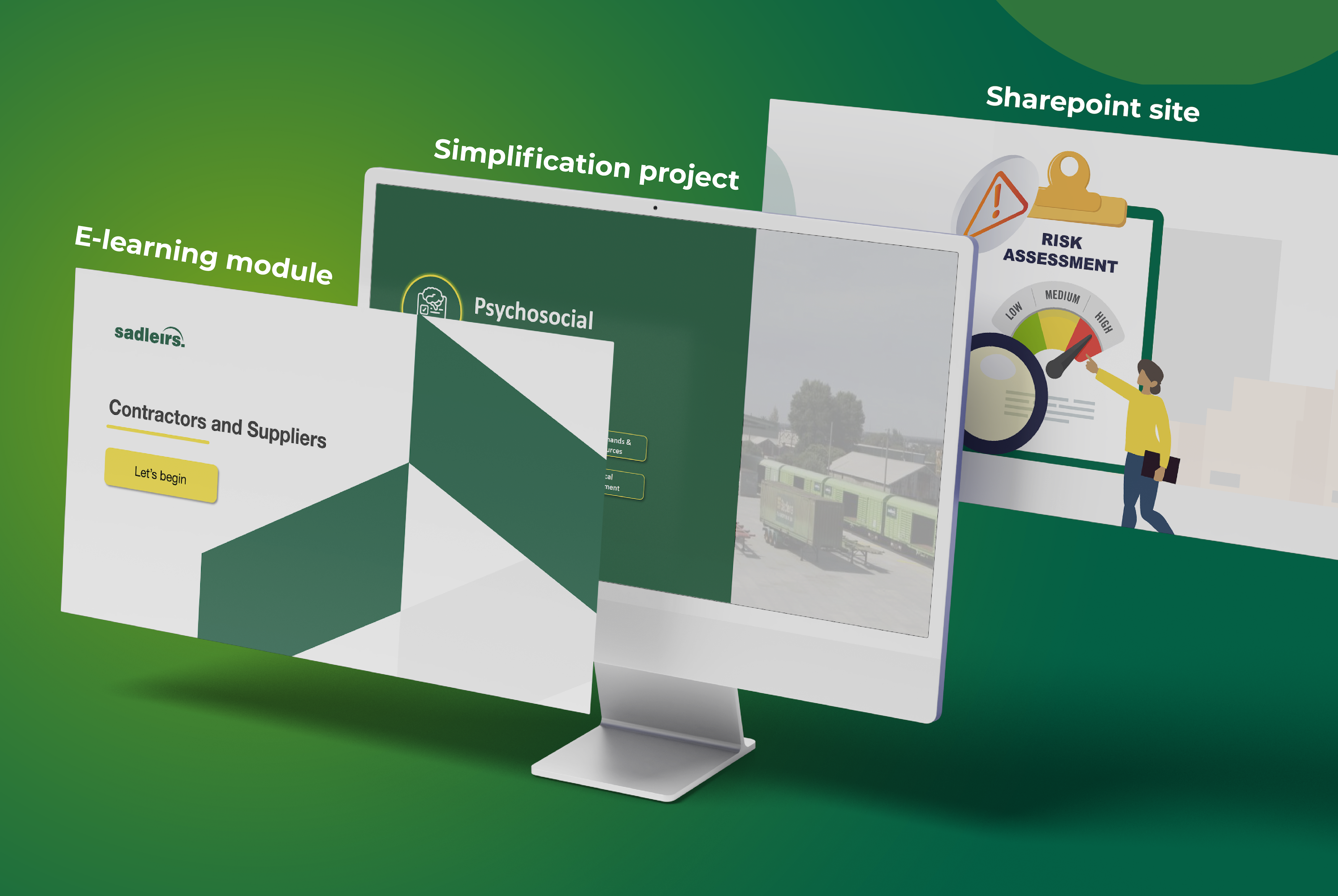
HSE Central, a purpose-built SharePoint platform
A single point of access to standards, tools and risk information nationally
↔
Drag, or use the arrow keys
This work was centralised on HSE Central, a purpose-built SharePoint platform giving workers and contractors a single point of access to standards, tools and risk information nationally, replacing the absence of any central risk repository described in Question 1.
When co-designing the HSE Management System and its supporting modules, Sadleirs ran online workshops for each risk topic to gather input and review content, engaging Executives, Managers and Supervisors, the group responsible for understanding and implementing the framework in practice. Some more complex topics required more than one workshop, while related topics were sometimes combined into a single session, and content was iteratively revised based directly on the feedback received.
Design principle
A key design principle throughout was simplicity for the frontline.
Rather than requiring workers to interpret the full HSE Management System directly, the risk framework was deliberately structured to cascade risk information down into Safe Operating Procedures (SOPs), the single document frontline workers need to understand risks and mitigate controls associated with their tasks.
This was informed directly by frontline consultation. More than 70 existing SOPs were outdated, text-heavy and image-free, and feedback from workers and supervisors identified these as difficult to use in practice. In response, the HSE Team worked directly with relevant supervisors and workers to design a new SOP template, reducing wording and introducing pictures, and consolidated the 70+ outdated documents into 55 SOPs covering each task.
These SOPs are now owned by operations, integrated into new worker onboarding, and reviewed at least yearly with workers.
04What was builthover a panel
The platform
HSE Central
A purpose-built SharePoint platform giving workers and contractors a single point of access to standards, tools and risk information nationally.
318 unique viewers · 101,779 site visits since launch
The framework
Site Risk Register
Structured around 14 key risk areas, within which several critical risks were identified and are mitigated by mandated critical controls, managed consistently across all sites.
70+ procedures → 17 standardised national standards
The frontline
55 SOPs
A new SOP template, reducing wording and introducing pictures, designed directly with relevant supervisors and workers.
Owned by operations · reviewed at least yearly with workers
Capability
SME program
Appropriately qualified and competent workers are selected and upskilled to independently conduct VOC assessments at their own sites.
Embedding capability at the workfront
Consultation
HSR program
Revamped, with each site encouraged to have HSRs and a mandated monthly HSR committee meeting introduced.
Actively engaged in safe operating procedure development, site inspections, and incident investigations
17 standardised national standards, 55 SOPs, and one place to find them.
Select to enlarge
Enlarge ↗
Building on this foundation, Sadleirs has since developed a full suite of standard-specific training modules, again in partnership with Opposite and taken through feedback rounds involving Executives, Managers and Supervisors, all reviewed and signed off by the Executive Team.
From 2023, this expanded into more than 14 new training programs and 27 verification of competency (VOC) assessments, delivered via Sadleirs’ online Learning Management System platform and face to face via its dedicated trainer, a certified national forklift assessor and DG expert with over 20 years’ experience in the transport and logistics sector.
Sadleirs is now extending this work into its Learning Management System through role-based onboarding plans. Workers with direct reports must confirm completion of all relevant modules, while other workers confirm completion of the foundational module covering the HSE Management System and how to navigate HSE Central.
The dedicated trainer also led the creation of a subject matter expert (SME) program, through which appropriately qualified and competent workers are selected and upskilled to independently conduct VOC assessments at their own sites, embedding capability at the workfront rather than relying solely on centralised assessment. Sadleirs has also mandated CoR, DG and Load Restraint champions at each operational site, directly targeting the load restraint and dangerous goods risks identified in Question 1.
05Training developed and implementedsince 2023
Training developed and implemented includes
Online National HSE Induction
site-specific face-to-face induction
mental health awareness training
DG awareness training
limited quantities DG awareness training
spill response training
load restraint awareness training
fatigue management training
mass management awareness
National Online Site Induction
psychological safety awareness
Sadleirs-specific CoR training
run sheet training
manual handling awareness training
This equates to over 10,000 hours of training invested into employees and contractors since 2023.
0
Hours of training invested into employees and contractors since 2023
0
New training programs
0
Verification of competency assessments
0
Years’ experience — dedicated trainer and DG expert
Operationally, Sadleirs introduced the Frontline Operational Huddle, an operations-led initiative reviewing dunnage use and increasing airbag utilisation to directly reduce the manual handling injury risk identified in Question 1, and released a dedicated Psychosocial Safety training module in response to rising stress-related claims. Sadleirs also partnered with its broker, Knightcorp, to better understand injury trends and inform future injury reduction initiatives.
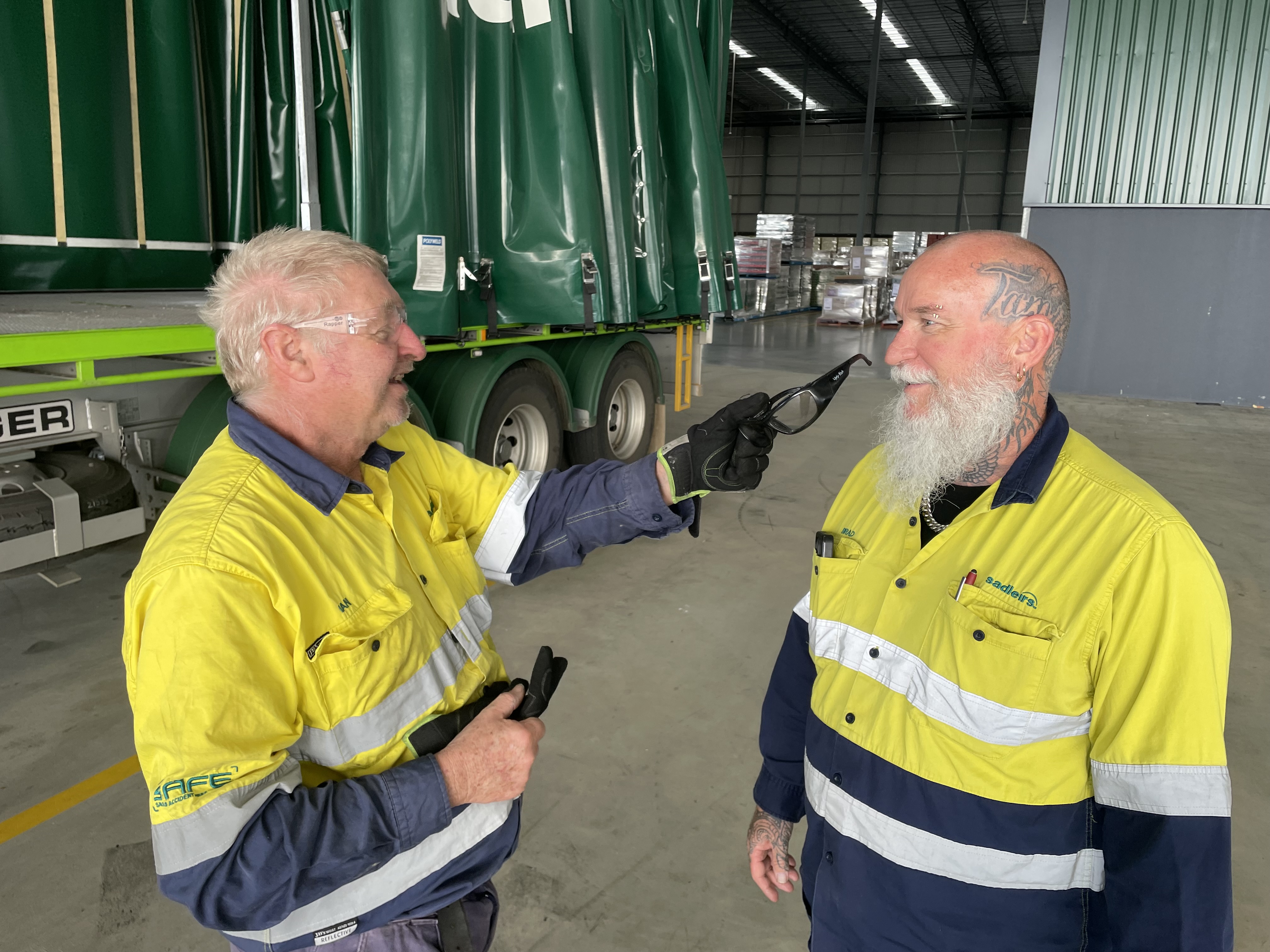
The Health and Safety Representative (HSR) program was also revamped, with each site encouraged to have HSRs and a mandated monthly HSR committee meeting introduced, with HSRs actively engaged in safe operating procedure development, site inspections, and incident investigations. Frontline workers and HSR representatives are also directly involved in risk reviews, particularly Management of Change (MoC) risk assessments, drawing on their subject matter expertise of the operational tasks involved.
06Genuine engagement, not a system on paper
0
Unique viewers on HSE Central
0
Site visits since launch
0
Invested in direct costs, plus indirect costs
0
Standardised national standards
Since HSE Central’s launch, the platform has recorded 318 unique viewers and 101,779 site visits, reflecting genuine engagement rather than a system that exists on paper only. Sadleirs has invested almost $600,000 in direct costs, plus an unquantified amount in indirect costs, into this uplift.
04
Question 3
A reduction of over 91% in three and a half years.
Improvement that is actively monitored and managed, rather than left to chance.
Potential SIFFR
41.71
From 41.71 in January 2023 to 3.52 as of August 2026 ↓ over 91%
Since Sadleirs began formally tracking its Potential Serious Injury Fatality Frequency Rate (SIFFR) in January 2023, as part of its national risk management uplift, the rate has improved from 41.71 to 3.52 as of August 2026, a reduction of over 91% over three and a half years.
07Total Recordable Injury Frequency Rate
6.97
Dec 2024
5.28
Most recent
The Total Recordable Injury Frequency Rate (TRIFR) has also trended down over the same period, most recently sitting at 5.28, down from 6.97 in December 2024. The Average Actions Close Out Rate has held at 86%, with lead indicators consistently exceeding monthly targets, evidence that improvement is being actively monitored and managed rather than left to chance.
This improvement reflects an embedded system rather than a single initiative. The Site Risk Register, structured around 14 key risk areas each with critical risks mitigated by mandated critical controls, together with HSE Central as the ongoing platform for standards and tools, and a training and onboarding structure being extended into the LMS, ensures new and existing workers are verified against current standards on a rolling basis. The consistency of the Actions Close Out Rate over time reflects an established operating rhythm rather than a short-term push.
08Multiple dimensions
The results achieved span multiple dimensions.
Risk
From a risk perspective, the SIFFR reduction of over 91% since 2023, alongside a downward TRIFR trend, points to fewer and less severe incidents over time.
Human
From a human perspective, the introduction of a dedicated Psychosocial Safety training module reflects the organisation’s willingness to adapt its risk focus as new patterns emerge, extending beyond physical injury prevention.
Business
From a business perspective, an investment of almost $600,000 in direct costs demonstrates sustained leadership commitment, while 318 unique viewers and 101,779 site visits to HSE Central confirm the system is being actively used, not simply built and left dormant.
 Safety Award